Kategorie
Bookkeeping

Cash Flow Statement CFS Formula + Calculator

Second, it needs to calculate the net increase or decrease in its accounts receivable. Contrarily, if a business makes cash payments to its suppliers and vendors, it is reducing cash on hand. Therefore, the company will have an increased ending balance of $110,000.

  • The interest paid on a note payable is reported in the section of the cash flow statement entitled cash flows from operating activities.
  • For that reason, smaller businesses typically prefer the indirect method.
  • This means that net cash flow from operating is greater than the reported net income, regarding this cost.
  • But here’s what you need to know to get a rough idea of what this cash flow statement is doing.
  • Bonds also mention the dates on which the interest income becomes payable to the investor.

The two methods by which cash flow statements (CFS) can be presented are the 1) indirect method and 2) direct method. For example, XYZ Company purchased a computer on January 1, 2016, paying $30,000 upfront in cash and with a $75,000 note due on January 1, 2019. The interest expense is the bond payable account multiplied by the interest rate. The payable is a temporary account that will be used because payments are due on January 1 of each year. And finally, there is a decrease in the bond payable account that represents the amortization of the premium. From this CFS, we can see that the net cash flow for the 2017 fiscal year was $1,522,000.

Reporting Interest Paid on the Statement of Cash Flows

If the impairment or reversal of impairment affects the net profit before tax figure, it should be adjusted as if it never happened when preparing the statement of cash flows. Decreases in net cash flow from investing normally occur when long-term assets are purchased using cash. For example, in the Propensity Company example, there was a decrease in cash for the period relating to a simple purchase of new plant assets, in the amount of $40,000. Investing net cash flow includes cash received and cash paid relating to long-term assets.

  • Since interest expense is an important amount, the statement of cash flows must disclose the amount of interest paid.
  • First, let’s take a closer look at what cash flow statements do for your business, and why they’re so important.
  • Positive net cash flow generally indicates adequate cash flow margins exist to provide continuity or ensure survival of the company.
  • The cash impact is the cash proceeds received from the transaction, which is not the same amount as the gain or loss that is reported on the income statement.

Another useful aspect of the cash flow statement is to compare operating cash flow to net income. The cash flow statement reflects the actual amount of cash the company receives from its operations. After issuance, ABC Co. incurs an interest expense of $5,000 on these bonds. However, the company only pays its shareholders $4,000 during the year. This transaction will appear on ABC Co.’s cash flow statement as follows. The repayment of bonds means companies decrease their cash and cash equivalent balances.

How to Create a Cash Flow Statement

Changes in cash from financing are cash-in when capital is raised and cash-out when dividends are paid. Thus, if a company issues a bond to the public, the company receives cash financing. However, when interest is paid to bondholders, the company is reducing its cash. And remember, although interest is a cash-out expense, it is reported as an operating activity—not a financing activity. Changes made in cash, accounts receivable, depreciation, inventory, and accounts payable are generally reflected in cash from operations. While the direct method is easier to understand, it’s more time-consuming because it requires accounting for every transaction that took place during the reporting period.

How Does Accounts Payable Increase?

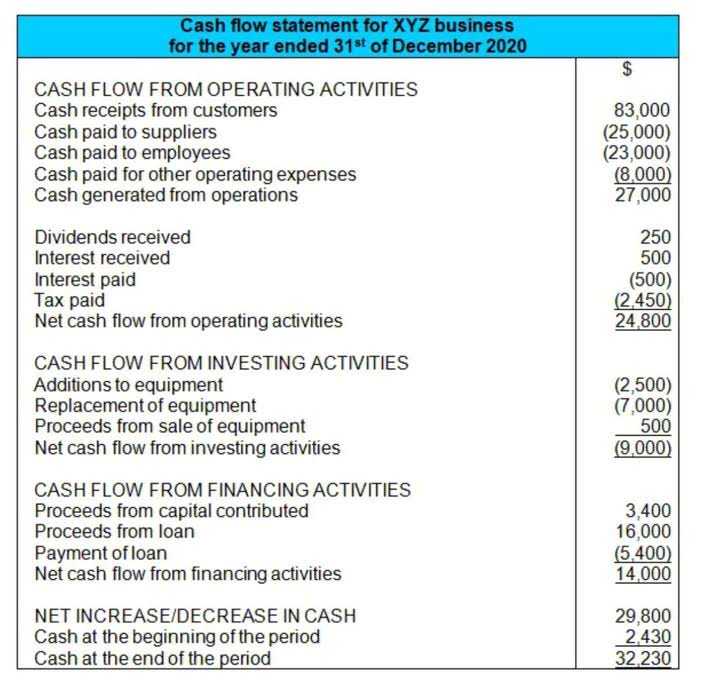
Using the cash flow statement example above, here’s a more detailed look at what each section does, and what it means for your business. In our examples below, we’ll use the indirect method of calculating cash flow. The cash flow statement takes that monthly expense and reverses it—so you see how much cash you have on hand in reality, not how much you’ve spent in theory. However, you’ve already paid cash for the asset you’re depreciating; you record it on a monthly basis in order to see how much it costs you to have the asset each month over the course of its useful life. IAS 7 was reissued in December 1992, retitled in September 2007, and is operative for financial statements covering periods beginning on or after 1 January 1994.

What is the Statement of Cash Flows?

Using the direct method, you keep a record of cash as it enters and leaves your business, then use that information at the end of the month to prepare a statement of cash flow. With the assets and liabilities side of the balance sheet complete, all that remains is the shareholders’ equity side. The completed statement of cash flows, which we’ll work towards computing throughout our modeling exercise, can be found below. Focusing on net income without looking at the real cash inflows and outflows can be misleading, because accrual-basis profits are easier to manipulate than cash-basis profits.

For small businesses, Cash Flow from Investing Activities usually won’t make up the majority of cash flow for your company. But it still needs to be reconciled, since it affects your working capital. But here’s what you need to know to get a rough idea of what this cash flow statement is doing. Hello, I am wondering why taxes of $8 were not deducted from the cash flow via the operating cashflows to get to $40 from the $48. Next, our company’s long-term debt balance was assumed to be $80m, which is decreased by the mandatory debt amortization of $5m.

Everything You Need To Master Financial Modeling

In exchange, investors get the promise to receive fixed and regular interest payments. However, companies do not have an obligation to return equity investments unless they go through liquidation. Similarly, companies only suffer optional cash outflows to equity investors. If the company can negotiate 7 basic invoicing questions you were afraid to ask better credit terms with its suppliers, it can improve cash flows. Suppose the company successfully negotiates the credit period to 60 days. The simple rule to understand the relationship between the accounts payable and cash flow is to follow the directional movement of the cash flow.


Kategorie
Bookkeeping

Accounts Payable Definition, Turnover, Reducing

accounts payable

Keeping track of AP lets your business stay on top of its obligations while making wise financial decisions. Paying suppliers on time not only prevents extra costs but also builds trust and strengthens business relationship. With QuickBooks, you can automate expense management and get back to doing what you love about running your business.

  • It specifically refers to any amounts owed expected to be paid within one year or less (usually due in 30 to 60 days).
  • Conversely, if the company is the party that owes cash to a supplier or vendor, the issuance of the payment to settle these debt is recorded as a debit on the “Accounts Payable” account.
  • Below we’ll define accounts payable and how to set up an effective process for accounts payable management.
  • Owners must consider the timing of cash inflows from accounts receivable and the cash outflows required for accounts payable.
  • If yo receive an invoice mentioning the payment terms from your supplier, it then gets recorded in your accounts payable ledger.
  • Thus, the accounts receivable account gets debited and the sales account gets credited.

Reducing Accounts Payables

Businesses can streamline the accounts payable process with their accounting software tool. AP encompasses retained earnings balance sheet any amount of money a company owes besides payroll, including goods or services purchased, software subscriptions, logistics, late fees, or office utility bills. Depending on a company’s internal controls, an AP department either handles pre-approved purchase orders or verifies purchases after a purchase.

Accounts Payable: Definition, Example, and Journal Entry

Trade payables measure the cash payments owed to vendors to compensate for past orders of inventory-oriented resources. Once received and processed, the vendor issues an invoice to the company, requesting payment for the goods or services delivered. If the outstanding balance is not settled in a reasonable time, however, the supplier or vendor has the right to pursue legal action to claim the payment owed. The cash cycle (or cash conversion cycle) is the amount of time a company requires to convert inventory into cash. It is tied to the operating cycle, which is the total of accounts receivable days and inventory days. Generally Accepted Accounting Principles (GAAP) provide a framework of standards, guidelines, and procedures for financial accounting and reporting.

  • If you run a retail business, you might buy inventory from a supplier on a 60-day payment term.
  • Accounts Payable is presented as a current liability on a company’s balance sheet.
  • This method ensures that all transactions are properly tracked and the company’s financial position is accurately represented.
  • Instead, payables are booked as liabilities and are found on the balance sheet.
  • To carry out this practice, you’ll need to ensure that you have a proper accounts payable team, this team reviews supplier data for its completeness, accuracy, and compliance with standard terms.
  • If a company is owed more payments in the form of cash from customers that paid using credit, the “Accounts Payable” account is credited to reflect the increased obligation.

Does accounts payable go on the income statement?

accounts payable

The first step to calculate the accounts payable on the balance sheet is to determine the opening AP balance at the start of the period (or ending balance in the prior period). Use the tips discussed above to conserve cash and maintain good relationships with your vendors. Now is the time to take charge of the accounts payable process to improve your business results. The accounts payable (AP) department is responsible for implementing the entire accounts payable process.

accounts payable

accounts payable

A well-organized AP process helps your business balance payments and cash reserves, so you can cover expenses without financial strain. The accounts payable process doesn’t have to be a dreaded task when you habitually review your invoices weekly and implement accounting automation opportunities. The accounts payable process plays an important role in your business’s accounting operations for several reasons. The first step of the accounts payable process is to create a chart of accounts, which is an organizational chart that summarizes where you record accounting transactions.

Streamline the AP workflow

accounts payable

Delaying the payments for a few days would help Walmart Inc to hold more cash to eventually pay to its suppliers. However, delaying payments for too a long of a period would critically impact Walmart’s relationship with its suppliers. Based on Walmart’s payment schedule, its suppliers can determine the credibility of the company. For example, the suppliers would consider Walmart Inc to be a credible customer if it pays its suppliers within a decent credit period. When you’re starting your business, you’ll need to add the details of all your suppliers into your accounting software or Microsoft Excel Sheet.

accounts payable

In this article, we will talk about the what accounts payable means, the accounts payable journal entry, the accounts payable process, and examples of accounts payable. The two are essentially a mirror image on a company’s balance sheet—AP is a current liability, while accounts receivable is a current asset. Many things contribute to your small business’s success, but effectively managing cash flow is critical. Adding in the accounts Bookkeeping for Painters payable process is necessary for effective business accounting, but we know it can be time-consuming. Most businesses have these challenges when tracking accounts payable manually. With accounting software, you can track expenses to ensure your accounts payable process is more accurate.

  • Ledger accounts need to be updated based on the received bills and an expense entry is usually required.
  • Accounts payable, also known as AP, are the total debts that you owe to other businesses for products and services that they invoiced you for.
  • While accounts payable and pills payable may sound similar, they refer to different financial obligations.
  • The accounts payable department should use accrual accounting to post transactions and for financial reporting.
  • With automated accounts payable, you gain real-time insights into your financial status.
  • In addition to this, effective accounts payable management practices ensure that you’re building trust with your suppliers by honoring the agreed payment terms and paying your suppliers on time.
  • You’ll need to cross-check the goods received from your suppliers with those mentioned in the invoice and check whether you have received all the services that were mentioned in the vendor invoice.

Using an online invoicing software, like notes payable vs accounts payable QuickBooks, will help you automate your accounts payable process by going paperlessm meaning all your company’s bills can be created and sent via the invoicing software. Your company is paying slowly to its suppliers if its accounts payable turnover ratio falls relative to the previous period. This falling trend in the accounts payable turnover ratio may indicate that your company is not able to pay its short-term debt, and is facing a financial crunch.

Kategorie
Bookkeeping

What Does An Accounting Consultant Do: Duties And Responsibilities

The difference is that they’re 1.5% more likely to earn a Master’s Degree, and 0.0% more likely to graduate with a Doctoral Degree. An saas accounting is a person tasked to assist the accounting department of a company. The consultant advises businesses concerning the accounting system used by the organization.

  • The accounting consultant may then look at the company’s financial statements, gauge the profitability of the organization, and make some estimates on the company’s financial forecast.
  • By keeping learning, you can improve your performance, efficiency, and competitiveness as an accounting consultant.
  • This dynamic environment necessitates that accounting consultants possess the ability to adapt swiftly and provide services that meet their client’s evolving needs.

Which types of consultants are in biggest demand will likely change from year to year, as the profession continues to evolve to meet consumer needs. No matter the timing of your transition to accounting consulting, you will need to plan your new business in advance. There may be additional training or education to help you specialize in a particular type of consulting, but there are also other considerations that require some forethought. Challenges of being an accountant consultant include intense work pressure, long working hours during busy periods, and the need for constant skill upgradation to keep up with changes in regulations and technology. To succeed in accountant consultancy, one must possess analytical and problem-solving skills, communication and interpersonal skills, attention to detail and accuracy, and adaptability in a fast-paced environment.

Navigating the Challenges in Accountant Consultancy

Independent consultants and those who establish their consultancy businesses have the potential to earn even more. They offer strategic advice to ensure optimal utilization of financial resources, helping businesses meet both short-term and long-term objectives. Yes, an accounting consultant designs and implements effective accounting systems tailored to a business’s unique needs, improving accuracy and compliance.

  • For most, this begins with earning a bachelor’s degree in accounting or a related field, such as finance or business administration.
  • Accounting consultants must stay ahead of these changes to provide their clients the most current and effective solutions.
  • Being an accountant can mean far more than preparing tax returns, compiling financial statements, handling technical compliance work or providing back-office accounting services.
  • Businesses should understand what a potential consultant specializes in and what services they can provide.
  • Different consultants offer different services and have different areas of expertise.
  • Professional certifications endorse expertise, proficiency, and commitment to the profession.

This means meeting the expectations, deadlines, and budgets of your clients. It also means communicating effectively, solving problems creatively, and providing value-added insights and recommendations. By delivering quality work, you can establish your reputation, credibility, and trust as an accounting consultant.

Staff Accountant

An average senior staff accountant eans a higher salary compared to the average salary of accounting consultants. The difference in salaries amounts to senior staff accountants earning a $2,189 higher average salary than accounting consultants. A senior staff accountant is responsible for managing the accounting operations of the company’s accounting department, reconciling accounts, and finalizing financial reports to discuss with the management.

Accounting consulting: How to become an accounting consultant (and why)

A senior cost accountant is an individual who maintains detailed costs in a company’s system and provides cost analysis that supports operations and sales. Senior cost accountants are required to review inventory and deal with manufacturing personnel to control and analyze standard costs. They must record cost information to be used in controlling expenditures as well as recommend cost efficiencies in new product layouts. Senior cost accountants must also provide reports that specify and compare factors affecting prices and profitability of products or services to the management. Senior accountant analysts tend to reach similar levels of education than accounting consultants. In fact, they’re 1.6% less likely to graduate with a Master’s Degree and 0.0% more likely to earn a Doctoral Degree.

This is a collection of your previous projects, achievements, and testimonials that demonstrate your skills, experience, and results. You can create your portfolio on a website, a blog, a social media platform, or a online platform for freelancers. Your portfolio should include relevant information, such as your credentials, services, rates, contact details, and samples of your work. You should also update your portfolio regularly and ask for feedback and referrals from your clients. If you set up a home-based office and plan to have business-related professionals come to your home, you will need to determine what type of business-related liability and/or property insurance to obtain. If you have homeowner’s or renter’s insurance, you should inquire with your insurance company to determine what is covered.

Intrinsic Value of Hiring Accounting Consultants

Generally speaking, your clients will expect a fixed fee for consulting services. Not only that, but if you stick to hourly billing, you will need to take on and maintain more clients to increase your profits. With a fixed consulting fee, you charge for your value, above and beyond your time. Your clients pay you for your expertise, knowledge and guidance, and you will likely reap the rewards of that relationship in terms of more business from them and their referrals as well.

An accounting consultant, equipped with a deep understanding of a business’s unique needs, can develop an effective accounting system. These insights enable organizations to make informed decisions and bolster their financial health. Consultants should be proficient in the skills their prospective employer needs and be able to quickly adapt to the processes and procedures of their new workplace. As the field of accounting consultancy evolves, it will be increasingly important for consultants to stay updated on industry developments and continuously enhance their skills and knowledge.

Another challenge is the potential for businesses to become overly dependent on their consultants. This could create problems if the consultant is unavailable when important decisions must be made. Accounting consultants offer scalability and flexibility that may take work for businesses to achieve on their own. The results of this analysis are often presented to the client in the form of detailed financial reports.

Traditionally, the nature of accountancy means that you collect historical information and data and report on it. When working as an accounting consultant, you can take your expertise a step further. Being an accountant consultant offers advantages such as high demand in the market, the potential for a high income, and exposure to varied and challenging work. The pros of being an accountant consultant include high demand in the market, the potential for a high income, and challenging and diverse work. Regularly updating your knowledge and skills through courses, seminars, and further certifications is essential.

Kategorie
Bookkeeping

Search for tax exempt organizations Internal Revenue Service

5013c meaning

Due to the COVID-19 emergency, this year the IRS extended the filing dates for these returns and notices due from April 1 through July 14 to July 15, 2020. Organizations eligible for this relief that failed to file for the two previous years and did not file by July 15 have automatically lost their tax-exempt status. Due to systemic limitations, these organizations appear on the auto-revocation list showing a Revocation Date between April 1 and July 14, 2020. For more information on automatic revocation, including how to request reinstatement, see Automatic revocation – How to have your tax-exempt status reinstated. A 501(c)(3) nonprofit organization earns its classification from the Internal Revenue Service (IRS) based on its primary purpose.

Nonprofit Organization (NPO): Definition, Funding, vs. Not-for-Profit

She is the author of more than 40 books, is a nationally recognized expert on divorce and family law and has a depth of experience that include estates, probate, finance, business, bankruptcy and more. The Bookstime Federal Black Lung Benefit Act of 1969 required coal miners to pay a monthly compensation to miners who were fully disabled due to pneumoconiosis, or black lung disease, after being exposed to coal dust during their mining work. Surviving spouses can be compensated if they were widowed fully or in part due to black lung disease.

  • However, political campaign intervention for or against any particular candidate is prohibited as a primary activity.
  • That’s why our SureSTART program is designed to walk you through the process—step-by-step.
  • Articles of organization may consist of your organization’s corporate charter or articles of association.
  • He is registered with the IRS as an Enrolled Agent and specializes in 501(c)(3) and other tax exemption issues.
  • Nonprofits may receive donations of goods or services such as office supplies, equipment, or professional services.

Types of 501(c) Organizations

  • The 501(c)(3) status offers myriad benefits to the designated organizations and the people they serve.
  • Grants are typically awarded for specific projects or programs and may require the nonprofit to meet certain conditions or reporting requirements.
  • These organizations also often receive discounts from retailers, free advertising by way of public service announcements, and food and supplies from other nonprofit organizations designed to help in times of need.
  • Unlike 501(c)(3) organizations, donations given to 501(c)(4)s are typically not tax-deductible.
  • But, having a bias or tilt to your message is perfectly fine, as long as it’s not blatant bombast.

They operate around a central vision, such as addressing a social issue, promoting education or the arts, or providing healthcare to underserved populations. This vision can foster a sense of purpose Online Accounting for staff that may be lacking in a for-profit company. Form 990 requires organizations to provide detailed information about their revenue, expenses, assets, and liabilities. The form is very different from an individual’s tax form as there are many governance questions to ensure IRS compliance. Certain activities or expenditures may not be prohibited depending on the facts and circumstances.

  • With over 1.5 million registered 501(c)(3) nonprofits in the United States making up three-quarters of the nonprofit revenue, 501(c)(3) nonprofits are the most common type of nonprofit.
  • The organization itself can often tell you which sorts of donations are deductible, and to what extent—for example, if you buy a one-year museum membership for $100, $50 might be deductible.
  • Such organizations must also provide information to their members concerning loss control and risk management, must have obtained at least $1,000,000 in startup capital from non-charitable organizations and must not pool risk concerning medical malpractice.
  • Being “501(c)(3)” means that a particular nonprofit organization has been approved by the Internal Revenue Service as a tax-exempt, charitable organization.
  • The name comes from section 501(c)(3) of the IRS tax code, which defines the primary purposes of an organization that may qualify it for exemption from federal income tax liability.
  • The charitable organization must include its articles of incorporation and provide documents that prove that the organization’s mission qualifies it for tax-exempt status.

What does it mean to be a 501(c)( organization?

5013c meaning

If the IRS approves your nonprofit’s 501(c)(3) status, you will receive a determination letter confirming their recognition. However, having 501(c)(3) status comes with compliance requirements at both the state and federal level. For instance, annual filing requirements include a corporate annual report, IRS Form 990, and state charitable solicitations registration and renewal.

5013c meaning

How the IRS Defines Charitable Purpose

  • A private foundation is an organization that does not receive funds from the general public.
  • If an organization is labeled 501(c), it means it is a nonprofit organization concerned with providing a public benefit and is exempt from paying federal income taxes.
  • The main categories for nonprofits are charitable, church and religious, private foundations, political organizations and other miscellaneous nonprofits.
  • Donations to private foundations can be tax-deductible to the individual donor up to 30% of the donor’s income.
  • A nonprofit designation and tax-exempt status are given only to organizations that further religious, scientific, charitable, educational, literary, health, or other beneficial causes.

It is a trust that funds the retirement benefits of railroad workers and their dependent family members. As a pay-as-you-go pension system that pays out payments to its 5013c meaning beneficiaries, railroad retirement assets are invested to ensure the retirement benefits of participants. OK, so maybe you don’t want to start your own nonprofit organization, but you’d like to give to one. The IRS designates three main types of 501(c)(3) organizations that may be allowed to operate under the 501(c)(3) form.

Charitable purposes

5013c meaning

Then create your organization’s bylaws, which specify how the organization will be structured and governed. As mentioned, “not-for-profit” isn’t an official legal term and may be better understood as an exempt organization that falls under the IRS’s “other nonprofits” section. These are most commonly social welfare organizations, civic leagues, social clubs, labor organizations, veterans’ clubs and business leagues. These types of organizations may not benefit the greater society, but typically operate to serve the goals of their members, such as a business league that collects dues in order to host workshops for members. When you hear the term nonprofit, the first thing that typically comes to mind is a charity, or 501(c)(3) organization.

5013c meaning

Types of organizations exempt under Section 501(c)(

The 501(c) designation has expanded over time to encompass more types of organizations. That’s why our SureSTART program is designed to walk you through the process—step-by-step. We’ve helped over 25,000 nonprofits successfully launch, and we’re ready to help you, too. The International Federation of Red Cross and Red Crescent Societies provides global humanitarian aid during peacetime, such as assisting refugees. The International Committee of the Red Cross provides humanitarian relief for people who are affected by war or other armed conflicts. In both, 75% of its members must be past or present Armed Forces members.

Kategorie
Bookkeeping

What Is the Accounting Equation? Examples & Balance Sheet

a statement that shows the relationship between an individuals assets, liabilities, and equity.

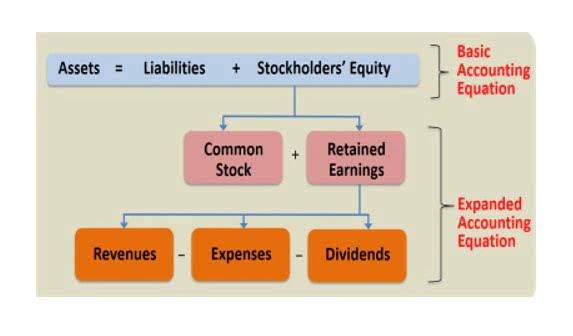
Gross profit is then often analyzed Accounting Security in comparison to total sales to identify a company’s gross profit margin. Shareholders’ equity is the total value of the company expressed in dollars. It’s the amount that would remain if the company liquidated all its assets and paid off all its debts. The remainder is the shareholders’ equity which would be returned to them. Assets and liabilities are key factors to making smarter decisions with your corporate finances and are often showcased in the balance sheet and other financial statements. Accounting software can easily compile these statements and track the metrics they produce.

What is the difference between a balance sheet and an income statement?

Identifiable intangible assets include patents, licenses, and secret formulas. Because the value of liabilities is constant, all changes to assets must be reflected with a change in equity. This is also why all revenue and expense accounts are equity accounts, because they represent changes to the value of assets.

What Is Included in the Balance Sheet?

  • The two primary categories of assets are current assets and non-current assets, both of which play a vital role in the accounting equation.
  • The main difference between the two is that the repayment of liabilities is required by law, unlike the repayment of equity which is discretionary.
  • The income statement provides deep insight into the core operating activities that generate earnings for the firm.
  • In the field of accounting, assets are defined as economic resources that are expected to provide future benefits or utilities to an entity.

In this example, Apple’s total assets of $323.8 billion is segregated towards the top of the report. This asset section is broken into current assets and non-current assets, and each of these categories is broken into more specific accounts. A brief review of Apple’s assets shows that their cash on hand decreased, yet their non-current assets increased. The financial statement only captures the financial position of a company on a specific day. Looking at a single balance sheet by itself may make it difficult to extract whether a company is performing well.

What are the elements of financial position?

Liabilities are presented in order of their expected settlement, with the liabilities that are expected to be settled first listed first. Paid-in capital is the amount of capital that shareholders have invested in a company. Treasury stock is stock that a company has bought back from shareholders.

  • One commonly used ratio is the debt-to-equity ratio, which measures the amount of debt a company has relative to its equity.
  • The balance sheet, on the other hand, is broader, revealing the full value of what the company owns and owes.
  • Owner contributions, also known as capital contributions or investments, further enhance the equity section of the accounting equation.
  • The $300 loss simply indicates that she received less for the land than she paid for it.
  • At the same time, the remaining balance is put under long-term liabilities.

Think of the balance sheet as being similar to a team’s overall win/loss record—to a certain extent a team’s strength can be perceived by its win/loss record. Now it is time to bake the cake (i.e., prepare the financial statements). We have all of the ingredients (elements of the financial statements) ready, so let’s now return to the financial statements themselves. Let’s use as an example a fictitious company named Cheesy Chuck’s Classic Corn. This company is a small retail store that makes and sells a variety of gourmet popcorn treats.

  • This change must be offset by a $500 increase in Total Liabilities or Total Equity.
  • That is, a corporation is “stand alone,” conducting business as an entity separate from its owners.
  • The differentiating factor is equity, which reflects the owners’ stake in the business after all liabilities have been settled.
  • This formula is used to ensure that the equation remains in balance and that the financial statements are accurate.

a statement that shows the relationship between an individuals assets, liabilities, and equity.

The balance sheet and income statement provide important information about a company’s financial position and performance. By understanding these statements and the accounting equation, investors and stakeholders can bookkeeping make informed decisions about a company’s future prospects. The purpose of a balance sheet is to show what a company owns (assets), what it owes (liabilities), and what is left over for the owners (equity). It is a key tool for assessing a company’s financial health and its ability to meet its financial obligations. The balance sheet is one of the three primary financial statements used by businesses to assess their financial health. The other two financial statements are the income statement and the cash flow statement.

a statement that shows the relationship between an individuals assets, liabilities, and equity.

The balance sheet

a statement that shows the relationship between an individuals assets, liabilities, and equity.

Assume that a mechanic performs a tune-up on a client’s car on May 29, and the customer picks up her car and pays the mechanic $100 on June 2. If the mechanic were using the cash method, the revenue would be recognized on June 2, the date of payment, and any expenses would be recognized when paid. In the Statement of Owner’s Equity discussion, you learned that equity (or net assets) refers to book value or net a statement that shows the relationship between an individuals assets, liabilities, and equity. worth. In our example, Chris’s Landscaping, we determined that Chris had $250 worth of equity in her company at the end of the first month (see Figure 2.2).

Kategorie
Bookkeeping

Accounting Concepts: Types, Examples & Principles

3 basic accounting principles

By using the same methods, trends in profitability, solvency, and other financial metrics become clearer. This allows for better analysis of a company’s financial health and future prospects. By applying these principles, businesses can ensure that their financial reports are reliable and provide valuable insights into their financial health.

Any expenses in a business are entered as debit and credited to the account which receives the funds. The personal account, which serves as a private repository for people, businesses, and other associations, comes next. On the other hand, the historical form of performance is a nominal account, and it involves keeping track of all earnings, profits, losses, and outlays. That, in simple terms, translates to the recording of financial transactions systematically to keep a record of the transactions. It also requires keeping the accounts updated with the most current transaction updated, reflecting an accurate picture of an institution’s current financial condition. Despite some progress under the Norwalk Agreement, the FASB and the IASB continue to battle friction resulting from fundamental disagreements at the governance level.

Rules of Accounting

  • The conservatism or prudence concept believes in playing safely, while recording the transactions in the book of accounts.
  • They bring uniformity to financial statements, making it harder for firms to hide information and inflate their numbers.
  • In fact, the full disclosure concept is not usually followed for internally-generated financial statements, where management may only want to read the “bare bones” financial statements.
  • For instance, when a company reports its revenue, it must be based on actual sales that have occurred and are verifiable through sales records and customer invoices.
  • This ensures the maintenance of accurate and clear records, enhancing the accuracy and reliability of financial statements.
  • The matching principle requires businesses to match expenses with the revenues they generate.

The double-entry method, on the other hand, records your expenses and accounts in the appropriate categories. It tells you how much you’re spending on a particular expense category and tracks future spending. The double-entry bookkeeping method is the most common strategy used by accounting software, large corporations and CPAs. These are the basic ideas or assumptions under the theory base of accounting that provide certain working rules for the accounting activities of an organization. https://kozelskgp-adm.ru/novosti/novosti_regiona/ministerstvo-konkurentnoi-politiki-kaluzhskoi-oblasti-informiruet-2 There are 13 important Accounting Concepts that are to be followed by companies to prepare true and fair financial statements.

  • The uniform structure makes the financial data presentable, making it easy to read and understand.
  • The journal entries are passed on the basis of the Golden Rules of accounting.
  • By understanding these concepts, accountants can ensure that financial information is recorded and reported accurately and in compliance with accounting standards.
  • If you want to keep your books up-to-date and accurate, follow the three golden rules of accounting.
  • Let’s first understand the role of accounting in a business, to whom it applies, and find out the benefits of good accounting practices that follow these three golden accounting rules.
  • The Generally Accepted Accounting Principles (GAAP) are a set of accounting principles, standards, and procedures that are recognized as authoritative by accounting professionals.

Types of Accounts

By accurately recording and reporting financial data, businesses can improve their performance, maintain compliance, and make sound financial decisions. Maintaining the accounts of financial transactions according to the golden rules of accounting gives certain advantages. A nominal account is a normal ledger account that records all income, expenses, profits, and losses for a business. Personal accounts are used to record transactions related to persons, firms and companies.

Consolidation & Reporting

3 basic accounting principles

Check out a couple of examples of this first golden rule of accounting below. A/c is a personal account so Dr. the receiver (11,000), Sales is a Nominal account so Cr. Purchases are an expense for the business therefore it is https://www.alfoot.net/news/daniel-telemann.html a nominal account.

What Are the Three Golden Rules of Accounting? Explained with examples

The FASB specifically creates the standards that all publicly traded companies must follow when reporting their financial statements. These principles help improve the quality of financial information that companies report. In business, appreciating the theory behind accounting is as important as applying it practically.

Accounting principles aim to provide consistency in financial reporting across different companies and industries. However, some argue that this can lead to a lack of comparability between companies, making it difficult for investors and analysts to make informed decisions. Mastering accounting not only secures your business now, but also helps it grow in the future.

Example 1 – Golden Rules

When a firm properly calculates its financial statements, it assists in proper business valuation. Furthermore, it helps in getting more investments and thereby expanding the business. Together, these principles form the bedrock of sound accounting practices, ensuring that financial information is accurate, consistent, and useful to those who rely on http://paladinum.ru/?p=245560&lang=en it. Type and Rules – Salaries A/c is a nominal account so Dr. all expenses (90,000), Bank is a personal account so Cr.

3 basic accounting principles

It is a truth since something has been purchased, and the selling price can be verified. As a result, the cost principle and facts are the foundation of accounting. To understand these rules, we need to take them individually and in the proper context. Let’s first understand the role of accounting in a business, to whom it applies, and find out the benefits of good accounting practices that follow these three golden accounting rules. Accounting has been around since time immemorial and can be traced back to Mesopotamian civilizations. The father of accounting, Luca Pacioli, was the first person to talk about Double-Entry bookkeeping, a practice still in use today.